Geotechnical Foundation Specs for Mountain Structures
The interface between an engineered structure and mountainous terrain requires complex geotechnical analysis. Unlike flat, stable lowland construction, alpine foundations must contend with aggressive topography, variable soil bearing capacities, subsurface water flow, and extreme freeze-thaw cycles. Our audits track the specific foundation topologies utilized to secure structures to steep inclines.
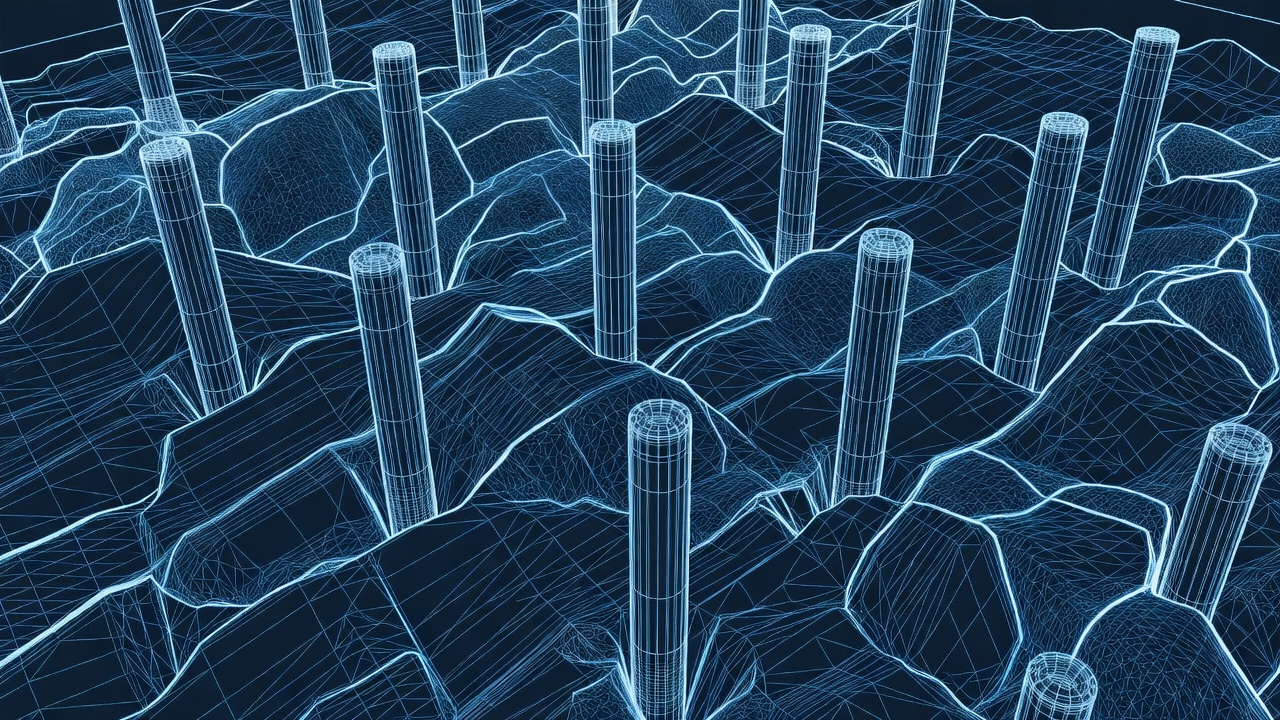
Frost Line Mitigation
The primary threat to shallow foundations in alpine environments is frost heave. When water within the soil profile freezes, it expands by approximately 9%, exerting massive upward forces against structural footings. To prevent differential settlement and structural fracturing, foundations must extend below the maximum localized frost depth.
In areas audited across the Swiss Alps, frost lines frequently exceed 1.5 meters. Excavating continuous strip footings to this depth across solid rock is both economically prohibitive and environmentally destructive. Consequently, engineers employ localized point-load foundations, utilizing isolated concrete piers or steel micropiles that penetrate below the active frost zone. Furthermore, the installation of rigid extruded polystyrene (XPS) skirt insulation around the perimeter can artificially raise the frost line by retaining the building's geothermal heat leakage.
Bedrock Anchoring Systems
Where the topographical incline exceeds 30 degrees, friction-bearing foundations become inadequate against downhill slip vectors. In these scenarios, structural loads must be transferred directly into stable bedrock. Ground-penetrating radar and core sampling determine the depth and competency of the underlying rock.
Once competent bedrock is located, pneumatic drills create boreholes to receive high-tensile steel anchors. These anchors are tensioned and grouted into place with expanding, high-strength epoxy or cementitious mixtures. A reinforced concrete ground beam is then cast over the anchor heads, creating a rigid platform. This technique effectively pins the structure to the mountain, utilizing the rock's immense shear strength to counteract lateral forces induced by gravity, wind, and potential seismic activity.
"Foundation engineering on a 40-degree incline is less about supporting downward mass and entirely about resisting the mountain's constant effort to shed the structure."
Micropile Implementations
For sites characterized by deep, unconsolidated glacial till or scree slopes, reaching bedrock may be impossible. Here, micropile foundations offer the superior solution. Micropiles are small-diameter (typically 100mm to 250mm) drilled and grouted piles containing a central steel reinforcement casing or threaded bar.
Their primary advantage lies in their installation methodology. The drilling equipment required for micropiles is highly compact, allowing for helicopter transport to remote ridges where heavy tracked excavators cannot operate. The piles develop load-bearing capacity primarily through skin friction between the grout and the surrounding soil matrix. By installing these piles in angled arrays (battered piles), the foundation matrix can resolve complex multi-directional load vectors.
Concrete Admixtures in Sub-Zero Climates
Pouring concrete at high altitudes presents severe chemical challenges. If the water within the concrete matrix freezes before primary hydration occurs, the compressive strength of the cured material is permanently compromised, often reduced by over 50%. To facilitate late-season construction schedules, specific chemical admixtures are strictly monitored.
Accelerators (such as calcium chloride, though restricted near steel reinforcements due to corrosion) are used to speed up the hydration process, which is an exothermic reaction generating its own heat. Additionally, air-entraining agents introduce microscopic bubbles into the mix, providing expansion chambers for internal moisture during freeze-thaw cycles over the lifespan of the structure. Formwork must often be insulated or actively heated during the initial curing phase to guarantee structural integrity matches the specified blueprint metrics.